

Mesh Coils vs. BVC (Spiral) Coils in Modern Vaping

Photo: @Digital Imports
The evolution of vaping technology has moved at a staggering pace over the last decade. What started as simple, low-wattage cigalikes has transformed into a sophisticated industry driven by advanced thermodynamics, precision engineering, and a constant quest for the ultimate flavor and vapor production. At the heart of every electronic cigarette or personal vaporizer lies the atomizer coil, the tiny engine responsible for transforming e-liquid into the aerosol that users inhale.
For years, the standard method for heating e-liquid relied on traditional round-wire wrapped in a spiral configuration, commonly known as Bottom Vertical Coil (BVC) or standard round-wire coils. However, the introduction of mesh technology revolutionized the market, offering a completely different approach to surface area and heat distribution. Understanding the fundamental differences between mesh coils and BVC coils can help vapers make informed decisions tailored to their preferred vaping styles, whether they are chasing massive clouds or seeking a faithful flavor profile for high-nicotine salts.
Understanding the Contenders: What Are They?
To appreciate the debate, it is essential to first understand how each coil design operates under the hood. Let’s dive into each type of coil here.
BVC (Bottom Vertical Coil)

Photo: @Digital Imports
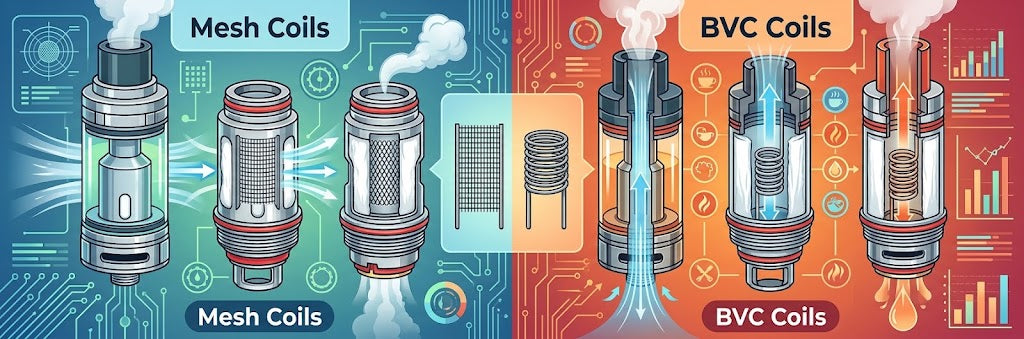
The traditional BVC design features a single or multiple strands of resistance wire (such as Kanthal, Nichrome, or Stainless Steel) wrapped into a vertical cylindrical spiral. The cotton or organic wick material is typically packed tightly against the inner or outer walls of this metal coil. When power is applied from the mod, electrical current flows through the wire, heating it up via resistance. The liquid absorbed by the wick comes into contact with the hot wire, vaporizing instantly. Because the wire is vertical, airflow typically travels straight up through the center of the cylinder.
Bottom Vertical Coils are tailored for mouth-to-lung (MTL) vapers, transitioners stepping away from traditional cigarettes, and those who prioritize discretion and nicotine satisfaction over cloud volume. If your daily rotation consists of high-nicotine freebase liquids, or nicotine salts, a BVC coil provides the tight, cigarette-like draw and sharp throat hit you need. It is ideal for stealth vapers and minimalists who run low-wattage pod systems or pen-style devices, demanding reliable, consistent performance without burning through battery life or filling a room with vapor.
Mesh Coils

Photo: @Digital Imports
Mesh coils throw out the traditional wire spool entirely. Instead, they utilize a wide, flat sheet of perforated metal, usually carved from Kanthal or Stainless Steel with a precise grid pattern resembling window screen mesh. This sheet is curved into a cylinder and lined with cotton. Because of the micro-holes punched across the entire surface area, electrical resistance is distributed much more evenly across a significantly broader physical space. When activated, the entire mesh sheet glows uniformly, contacting a massive surface area of e-liquid simultaneously.
Mesh coils are engineered for flavor-chasers, cloud enthusiasts, and direct-to-lung (DTL) vapers who want an immersive, high-performance experience. If you prefer complex fruit blends, rich custards, or heavily sweetened desserts, mesh technology unlocks subtle flavor notes that traditional wires simply miss. It is the perfect choice for users operating advanced sub-ohm tanks or powerful box mods who crave instant ramp-up times, massive vapor production, and a smooth, saturated draw that maximizes every single drop of juice.
Surface Area and Heat Distribution
The single greatest technological differentiator between mesh and BVC coils lies in their surface area-to-mass ratio and how they manage heat.
In a traditional BVC setup, the heating element is a narrow wire. Even in "clapton" or complex multi-strand wire builds, the actual surface area touching the wicking material is relatively localized. This creates localized "hot spots" points where the wire gets significantly hotter than the surrounding metal. These hot spots can lead to uneven vaporization, faster degradation of the e-liquid, and an increased risk of burning the cotton wick if the juice flow doesn’t work effectively.
Mesh coils, conversely, maximize surface area exponentially. By spreading the electrical current across a wide metallic sheet, the heat is dispersed evenly across the entire wick. There are no isolated hot spots. Consequently, e-liquid is vaporized uniformly across the entire grid. This uniform heating prevents localized scorching and ensures that every droplet of e-liquid is utilized efficiently, resulting in a smoother, more consistent draw from the very first puff to the last.
Flavor Clarity and Profile Accuracy
For most flavor-chasers, the battle between mesh and BVC coils is won or lost on taste. However, "better flavor" is not a universal constant; it heavily depends on the complexity of the e-liquid and the vaping style.
Mesh Coils and Complex Profiles: Mesh coils are renowned for bringing out distinct, nuanced notes in complex e-liquids, particularly fruit blends, dessert juices, and complex bakery profiles. Because the entire mesh sheet heats up instantly at a lower average temperature, it vaporizes lower-boiling-point flavor compounds without burning them away. The result is a vibrant, saturated flavor that feels punchy and pronounced.
BVC Coils and Tobacco/Subtle Notes: Traditional BVC coils excel in a different arena. For vapers who prefer high-nicotine freebase liquids, nicotine salts, or authentic tobacco and dry-leaf extracts, a BVC coil often provides a more restricted, focused throat hit and a tighter flavor delivery. The denser, more concentrated heat of a spiral wire can simulate the physical sensation of smoking a traditional cigarette more accurately than the wide, airy sweep of a mesh sheet.
Vapor Production and Cloud Density
If your primary goal is dense, voluminous vapor production, mesh coils hold a clear structural advantage.
Because mesh provides a massive surface area, it evaporates a larger volume of e-liquid per split-second of activation compared to a thin spiral wire. This translates into thick, billowy clouds even at moderate wattage levels. Sub-ohm tanks utilizing mesh coils have largely dominated the direct-to-lung (DTL) market for this exact reason, allowing cloud-chasers to achieve massive vapor output without needing excessively high battery power or dangerously low resistances.
BVC coils are typically engineered for mouth-to-lung (MTL) vaping or restricted direct-to-lung (RDTL) setups. While they can produce respectable vapor when pushed with higher wattages, their smaller surface area means they generate lighter, more discreet clouds. For stealth vapers or those using office-friendly setups, the restrained vapor production of a BVC coil is often seen as a benefit rather than a drawback.
Ramp-Up Time and Power Efficiency
Battery life and device responsiveness are crucial factors for everyday vapers. How quickly a coil reacts to the fire button can define the user experience.
Ramp-Up Speed: Mesh coils have an exceptionally low thermal mass relative to their surface area. Because the metal sheet is thin and perforated, it heats up almost instantaneously upon pressing the fire button. There is virtually zero ramp-up delay.
BVC coils, especially thicker or multi-strand variations, often suffer from a noticeable delay where the user must wait a fraction of a second for the wire to reach operating temperature.
Energy Consumption: Because mesh coils heat up so efficiently at lower wattages, they can deliver satisfying performance without draining your device's battery as quickly as a heavy, power-hungry custom wire build.
However, compared to standard tiny MTL BVC coils running at 10-15 watts, high-wattage mesh sub-ohm coils will naturally consume more battery life due to their overall power demands.
Coil Longevity and Maintenance
No discussion of vape coils is complete without addressing lifespan. Coils are consumable items, and replacing them frequently can become an expensive habit.
Generally speaking, mesh coils tend to outlast traditional BVC coils when paired with sweet, heavily sweetened commercial e-liquids (often referred to as "coil killers"). Because the heat is distributed evenly across a wide mesh sheet, sweetener residue (sucralose caramelization) doesn't concentrate in one destructive hot spot. Instead, it spreads out, delaying the onset of burnt-tasting gunk buildup.
However, longevity also depends heavily on user habits, such as:
Chain Vaping: Taking rapid, consecutive puffs without allowing the wick to re-saturate will quickly destroy both coil types, though mesh can sometimes tolerate slightly better liquid flow due to its wide contact area.
E-Liquid Composition: High-VG juices are thicker and tend to gunk coils faster than high-PG blends, regardless of coil architecture.
Choosing the Right Coil for Your Vaping Style
Ultimately, neither coil technology is universally "better" than the other; rather, they serve distinct purposes within the vaping ecosystem.
Choose a Mesh Coil if: You love sub-ohm vaping, prefer direct-to-lung (DTL) draws, enjoy complex fruit or dessert e-liquids, and want maximum flavor saturation, massive vapor clouds, and rapid firing times.
Choose a BVC (Spiral) Coil if: You are an MTL (Mouth-to-Lung) vaper, use high-nicotine salt e-liquids, prefer a tighter draw that mimics smoking, and value discretion, throat hit, and lower power consumption over huge clouds.
As vaping technology continues to evolve, we may see hybrid designs that combine the focused throat hit of spiral wires with the expansive surface area of mesh. Until then, knowing the strengths and weaknesses of each allows you to tailor your hardware choices to your exact personal preferences, ensuring an optimal vaping experience every single time.
Key Takeaways
Short on time? Here are the primary differences and considerations when choosing between mesh coils and traditional Bottom Vertical Coils (BVC):
- Core Design Difference: BVCs use traditional spiral-wrapped wire cylinders, whereas mesh coils utilize flat, perforated metal sheets lined with cotton.
- Heat Distribution: Mesh coils provide a larger surface area and even heat distribution, eliminating localized hot spots that often occur on traditional BVC wires.
- Flavor Profile: Mesh coils excel at bringing out nuanced notes in complex fruit or dessert e-liquids. BVC coils are better suited for tight, focused throat hits with high-nicotine, salt-nicotine, or tobacco-flavored juices.
- Vapor Output: Mesh coils produce larger, denser clouds for direct-to-lung (DTL) vaping, while BVC coils produce discrete, restrained vapor ideal for mouth-to-lung (MTL) stealth vaping.
- Performance Speed: Mesh coils feature a low thermal mass, allowing them to heat up almost instantly with zero ramp-up delay compared to spiral wire builds.
- Longevity: Mesh coils generally last longer when using sweet e-liquids because evenly distributed heat prevents sweetener residue from concentrated burning in single spots.
Need replacement coils? Check out Digitalimports.ca to find the right coil for you!